

Car Seat Safety
From the time you’re installing their first car seat until they’re getting their driver’s license, you want to make sure your child is as safe as possible in a car.
Prisma Health Children’s Hospital has the resources to help parents keep their children safe.
Car seat safety checks
Prisma Health Children’s Hospital offers car seat safety checks in the Midlands and Upstate.
Learn how to install a car seat
Watch our series of videos on how to properly install your car seat. You can also find helpful articles on other car safety topics.
Car seat guide for first-time parents, long-time caregivers and more
Check out the guide below to understand car seat safety guidelines and laws in detail. Our guide helps you keep your kids safe in the car, from that very first drive with your newborn through when to know when a tween is ready to leave their booster seat behind. Guide is available in English and Spanish.
Choose the right car seat for your child
Rear‑facing car seat
Children under age 2 should always ride in a rear-facing car seat in the back seat. There are different types of rear‑facing car seats: Infant‑only seats, convertible and 3‑in‑1 car seats. The latter two typically have higher height and weight limits for the rear‑facing position, allowing children to remain rear‑facing longer.
A rear‑facing car seat is the best seat for young children to use. It has a harness and, in a crash, cradles and moves with a child to reduce stress to the child’s fragile neck and spinal cord.
Forward‑facing car seat
Children should remain in a rear‑facing car seat until they reach the top height or weight limit allowed by the car seat’s manufacturer. It’s the best way to keep them safe. Once children outgrow the rear‑facing car seat, they are ready to travel in a forward‑facing car seat in the back seat. A forward‑facing car seat has a harness and tether that limits a child’s forward movement during a crash.
Booster seat
Keep children in a forward‑facing car seat with a harness until they reach the top height or weight limit allowed by the car seat’s manufacturer. Once a child outgrows the forward‑facing car seat with a harness, it’s time to travel in a booster seat – still in the back seat. A booster seat positions the seat belt so that it fits properly over the stronger parts of the child’s body.
Seat belt
Keep children in a booster seat until they are big enough to fit in a seat belt properly. For a seat belt to fit properly, the lap belt must lie snugly across the upper thighs, not the stomach. The shoulder belt should lie snug across the shoulder and chest and not cross the neck or face. Remember: Children should still ride in the back seat because it’s safer there. A seat belt should lie across the upper thighs and be snug across the shoulder and chest to restrain a child safely in a crash.
Age- and size-appropriate car seats that are properly installed can reduce the risk of being killed in cars by 71% among infants (under 1 year old) and 54% among toddlers (1 to 4 years old).
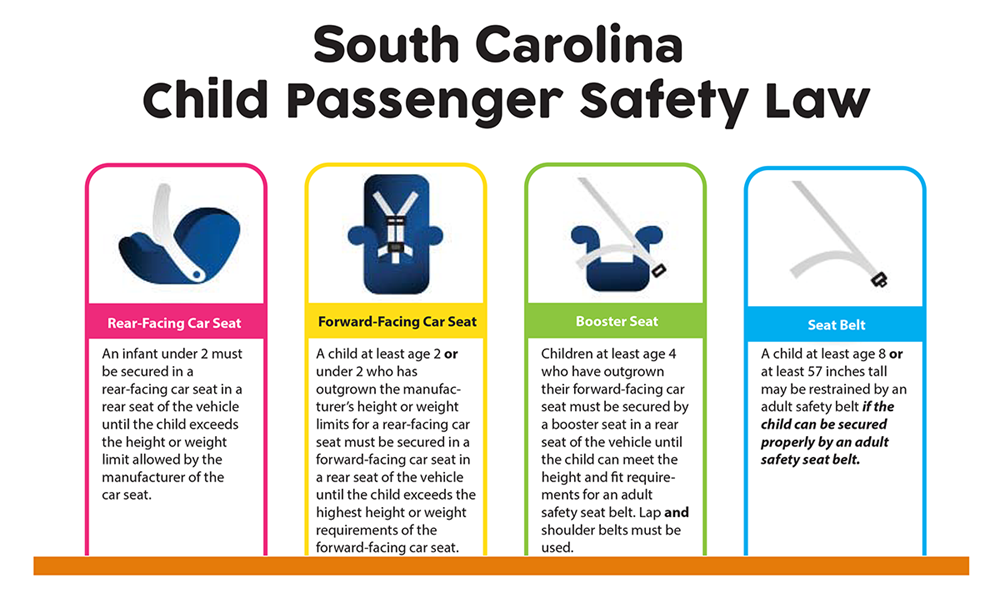 Image used with permission from the SC Department of Public Safety